Every time marijuana makes the news, questions start flying.
You’ve got drivers asking if it’s now legal to use CBD products. Safety managers become unsure what to tell their teams. Owners wondering if they have to rewrite parts of their drug policies. And, worst of all, plenty of people online confidently giving advice that is just plain wrong.
So, let’s slow down and look at what this really means.
Yes, marijuana is being reclassified federally from Schedule I to Schedule III. No, that does not mean CDL drivers can use it. And misunderstanding that difference can cost someone their career.
Why this topic is so confusing
The problem is not that people are careless. The problem is that the language used in these headlines sounds like permission. Words like “Rescheduled” or even “Recognized medical use” can be misleading.
If you are not living inside DOT compliance every day, it is completely reasonable to assume that rules have been changed. But in the world of trucking, reasonable assumptions can still lead to real consequences.
What drug schedules actually mean
Part of the confusion comes from the word “schedule,” so let’s clarify that first.
The federal government classifies drugs into five schedules under the Controlled Substances Act. These schedules are about medical use and abuse potential. They are not designed around commercial driving or public safety roles.
Schedule I
This has historically been reserved for drugs the government claimed had no accepted medical use and high potential for abuse. Examples include heroin, LSD, ecstasy, and until recently, marijuana.
Schedule II
These drugs have accepted medical use but are tightly controlled. Examples include fentanyl, oxycodone, methamphetamine, cocaine, and Adderall. These are legal when prescribed but still highly regulated.
Schedule III
These have accepted medical use and a lower abuse potential than Schedule I and II. Examples include ketamine, testosterone, anabolic steroids, and Tylenol with codeine. Marijuana is expected to fall here once the process is finalized.
Schedule IV and V
These include drugs with lower abuse potential such as Xanax, Valium, Ambien, and certain prescription cough syrups.
Here is the point…the schedule system is about medicine and law. DOT rules are about public safety.
There are plenty of Schedule II and Schedule III drugs that are perfectly legal with a prescription that still may disqualify you from driving if they impair your ability to operate safely. That reality does not change just because marijuana moves to a different category.
What has actually changed for CDL drivers
As of today, nothing.
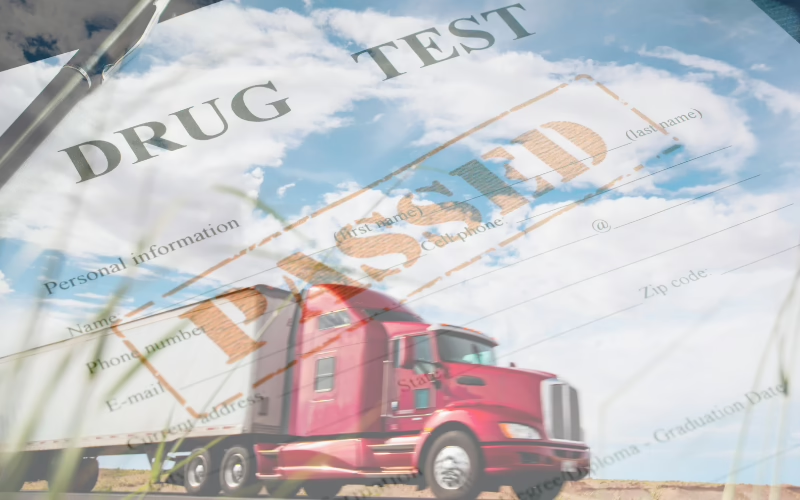
DOT drug testing rules still prohibit marijuana use for safety sensitive employees, which includes all CDL drivers, including owner operators. It also includes anyone subject to DOT testing such as a mechanic or driving instructor.
One of the biggest misunderstanding out there is that state legalization overrides federal DOT regulations. It does not. The federal law overrides any state legalization. Also, medical marijuana cards do not protect drivers under DOT testing. And a big thing to remember is CBD products that contain THC can still cause a positive test.
If a driver tests positive for marijuana, the process remains the same. They are immediately removed from safety sensitive duty. They must go through the SAP (Substance Abuse Professional) process. They must complete return to duty testing, and they must complete follow up testing. The harsh truth is that their record and potential job prospects are impacted.
This is not theoretical. This happens every single week to real drivers.
Why this matters so much
I am not interested in arguing policy. I am interested in protecting people’s livelihoods.
Most drivers are not trying to break rules. They are trying to live normal lives. They see headlines and hear conversations. They watch social media. They assume the rules have caught up with culture.
But DOT compliance does not work on assumptions. It works on black and white rulemaking.
Could things change in the future?
Possibly. There are real legal and regulatory questions being discussed. The authority for DOT testing is connected to how drug schedules are defined. That could create pressure for updates to the rules down the road.
But until DOT formally updates the regulations, every carrier, every safety manager, and every driver must treat marijuana as prohibited.
Advice for going forward
If you hold a CDL and you value your career, do not assume the headlines protect you. Do not trust TikTok advice. Do not rely on what someone else says their cousin got away with.
If you test positive, the system does not care what you believed. It only cares what the rule says.
If you run a fleet, this is a communication moment. Drivers need clarity, not silence. This is the time to reinforce policy, not relax it. The worst thing a company can do right now is assume everyone understands the nuance.
They don’t.
And when they make a mistake, they are the ones who pay for it.
Marijuana being rescheduled does not equal marijuana being allowed for CDL drivers. Until DOT says otherwise in official rulemaking, the safest and most accurate message remains simple. Marijuana and CDL driving still do not mix.
If you are a driver, protect your career.
If you are a carrier, protect your people.