
Fleets can’t control the price of diesel, but they can control how many gallons each truck burns. The five biggest levers are highway speed, driver behavior, idle time, tire pressure and aerodynamics. Where trucks fuel up matters too. A disciplined program can close a gap worth thousands of dollars per truck per year.
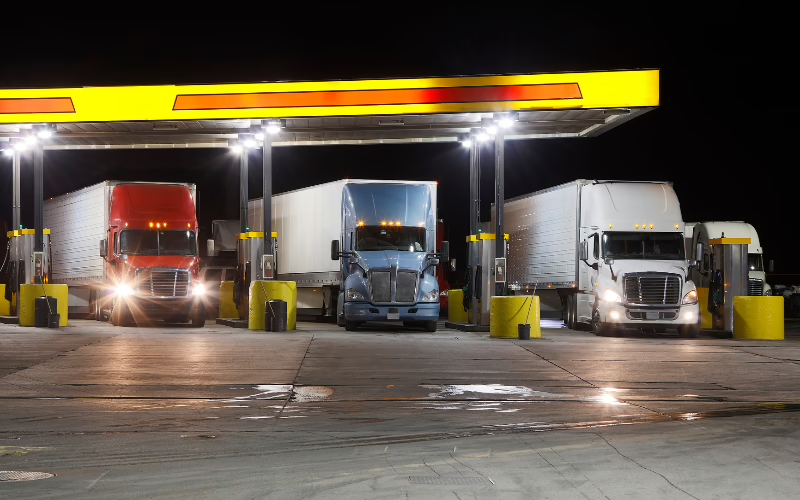
How much have diesel prices gone up?
The U.S. average diesel price hit $6.179 a gallon in October 2026, up from $3.665 a year earlier, according to the U.S. Energy Information Administration (EIA). That is an increase of roughly 69%. The EIA does not expect diesel to return to 2025 levels until 2028 at the earliest, even if tanker traffic returns to normal soon. Fuel jumped 17 spots to No. 1 in the American Transportation Research Institute’s (ATRI) 2026 Top Industry Issues report.
How much does a 1 mpg difference cost a truck per year?
A truck running 120,000 miles a year at 6.3 mpg burns about 19,050 gallons. The same truck at 7.5 mpg burns about 16,000 gallons. At October 2026’s $6.18 average, that 3,050-gallon difference costs roughly $18,800 a year. FreightWaves ran the same comparison at May 2026’s $5.60 pump price. At $6.18, the gap is larger.
The North American Council for Freight Efficiency (NACFE) tracked 14 fleets operating 75,000 trucks. Disciplined fleets averaged 7.8 mpg or better while the industry average was near 6.9 mpg. Most of that spread comes from a handful of factors a carrier controls.
How can a fleet improve fuel economy?
1. Slow down
Highway speed has a direct, measurable effect on fuel burn. The American Trucking Associations has documented that running 75 mph uses 27% more fuel than 65 mph. FreightWaves cites research putting the penalty at roughly 0.14 mpg for every mph over 65. For a truck averaging 6.9 mpg, a 600-mile run at 72 mph instead of 65 saves about 54 minutes but burns about 14 more gallons. That is roughly $89 per run at $6.18 a gallon.
2. Coach the driver, not just the truck
Industry studies put the driver’s influence on fuel economy at as much as 30%, according to CCJ. Hard acceleration is one of the biggest sources of wasted fuel. MIT research has found that aggressive driving at highway speeds can raise fuel consumption by 15% to 30%, and stop-and-go traffic can raise it by 10% to 40%. Consistent cruise control use can improve fuel economy by 7% to 14% on flat highways. Most modern engines run most efficiently between 1,250 and 1,350 RPM.
For fleets running more than a few trucks, the approach that works is driver-level telematics data, coaching tied to specific behaviors (speed, idle, acceleration) and a bonus for fuel performance.
3. Cut idle time
A Class 8 truck burns about 0.8 gallons an hour at idle, according to NACFE estimates. At $6.18, that is about $4.94 an hour, or $15 to $25 a day for a truck that idles three to five hours. NACFE estimates chronic idling can cost a single truck $4,000 to $6,000 a year. Engine-off HVAC systems and auxiliary power units (APUs) are the most common fixes. NACFE found a 20% idle reduction is possible with the right combination.
4. Check tire pressure
Underinflation is invisible and gradual. NACFE’s research found that running all tires 10 psi below recommended levels can raise fuel consumption by 0.5% to 1.0%. Check pressures every morning with a gauge, or add automatic tire inflation systems that top off air when pressure drops.
5. Improve aerodynamics
EPA SmartWay-verified testing has shown trailer side skirts alone deliver 7.4% fuel savings. Trailer tails add another 3% to 5%, and NACFE puts chassis fairings at 2% to 4%. Skirts, a roof fairing and cab-gap sealing typically pay for themselves within 12 to 24 months at recent fuel prices.
Skirts and tails go on the trailer, so power-only operators who don’t own the trailer can’t use them. For power-only loads, tractor-side upgrades like roof fairings and cab-gap seals are the aerodynamic changes in your control.
Does where you buy diesel affect fuel costs?
Yes. Where a truck fills up matters almost as much as how it is driven. Geotab analyzed 419,000 fill-ups across 660 U.S. fleets and found two tractors fueling in the same town on the same day could pay up to 77 cents per gallon apart. Build fueling plans into dispatch, not just drivers’ habits.
Does fuel-efficient driving also make trucks safer?
Many of the same habits that save fuel also reduce risk. Lower highway speeds, smoother acceleration and more following distance give drivers more time to react and reduce hard braking. A fuel program built on driver coaching supports a safety program built on the same data.
How do you start a fuel savings program?
Use this 30-day plan as a starting point.
- Week 1: Get a baseline. Record mpg per truck, idle share of engine hours, average highway speed and tire pressures.
- Week 2: Fix the low-cost items. Start morning tire checks, set idle-shutdown timers and write an idle policy for shipper waits and overnights.
- Week 3: Drop highway speed 5 mph. FreightWaves suggests holding the lower speed for 30 days and tracking mpg from fuel receipts. It reports that results show up within the first week.
- Week 4: Add accountability. Review driver-level data, start coaching and tie a bonus to mpg. Pull 90 days of fuel card data to see where trucks are fueling and what they are paying.
Frequently asked questions
How much fuel does a semi truck burn idling?
A Class 8 truck burns about 0.8 gallons of diesel an hour at idle, according to NACFE. At $6.18 a gallon, that is about $4.94 an hour.
How much fuel does driving 75 mph instead of 65 mph use?
The American Trucking Associations has documented that running 75 mph uses 27% more fuel than running 65 mph.
What is a good mpg for a semi truck?
NACFE found the industry average is near 6.9 mpg, while disciplined fleets average 7.8 mpg or better.
About Sam Watts
Sam Watts, Director of Safety & Loss Control, leads Ten Four Truck Insurance’s effort to help carriers navigate industry regulation so their companies can achieve compliance and thrive.